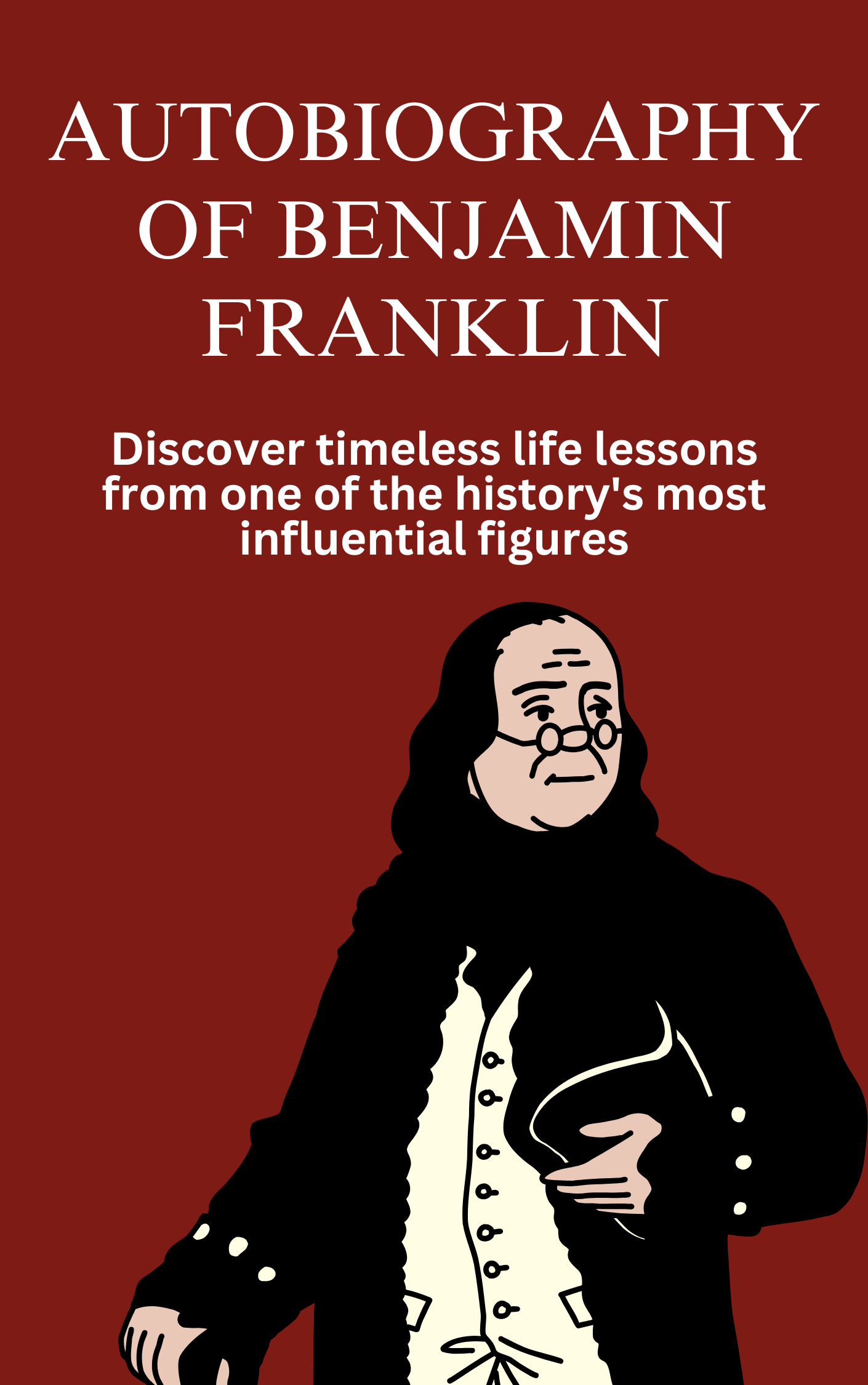
Most of us are waiting for an “Aladdin’s Lamp” that promises the secret to success. We dive into biographies of successful people to find this magic formula. And most of these biographies fall flat because they miss what truly grips us–the human element. But the autobiography of Benjamin Franklin–one of the most influential figures in American history–hits different. Why? Because it was intended as a letter to his son to simply share the lessons he’d learned the hard way. He’s refreshingly honest about the mistakes he made and the struggles he faced– going through the same everyday challenges we all do. THAT’S the human element which makes this autobiography a masterpiece!
And the story behind this autobiography is one to tell. Franklin began casually writing it back in 1771. Then came the turmoil of the American Revolution and the manuscript was lost–until 1784, when Franklin’s friend Abel James miraculously found a chunk of it and sent it to Franklin. Franklin picked up the pen again, now with a wider audience in mind: young readers who dreamed big like him. But poor health slowed him down, and the story ended abruptly in 1757.
After Franklin’s death, the manuscript went on its own wild journey. His grandson, William Temple Franklin, decided to edit and publish it, but in a true editor fashion, he couldn’t resist tweaking it–making over 1,200 changes to tone down the “vulgarity” of Franklin’s phrasing and making it more “appropriate” for the time. The result? A version that wasn’t quite Franklin anymore. It wasn’t until 1868 that the original version was restored by a certain John Bigelow. He came across the original, unedited manuscript in Paris while serving as the US consul. He was quick to realize its historical significance and undertook the task of publishing a new version–the true voice of Franklin–just the way he intended.
Here’s a sneak peek into Franklin’s life broken down in key phases.
Summary
A revolutionary hero and a founding father of the United States–Benjamin Franklin’s life is a testament to the power of curiosity, resilience, and commitment. His remarkable ability to navigate complex political landscapes with wisdom, pragmatism, and charm made him an indispensable figure in shaping the future of America. From his scientific innovations to his diplomatic triumphs, his legacy continues to inspire future generations after hundreds of years, showcasing that the key to greatness is the willingness to serve others while striving for constant improvement. His own words: “I would rather have it said, ‘He lived usefully,’ than, ‘He died rich,’” are a fitting reflection on his life.
From Humble Beginnings To An Eager Learner
Franklin had a humble beginning. He was born as the 15th of the 17 children to his father, Josiah. Despite his modest background, Franklin loved books. Even as a child, he used any money he could find to buy books. He even attended grammar school. But since his father couldn't afford the cost of higher education, he was pulled out pretty quickly and put to work in his father’s candle-making shop. He HATED it! Thankfully, his father noticed it soon...
The turning phase
Franklin soon realized that Keith’s promises were empty. And thus started the turn! He found himself stranded in London with no support. But he was determined to make the best of his situation, and found work at two printing houses, first at Palmer’s, and later at Watts’s printing house, where he honed his craft and gained valuable experience. After spending 18 months in London, he returned to Philadelphia in 1726 only to encounter another horror awaiting his return–Miss Read had...
The curious inventor
Most of us know Franklin for his famous kite experiment. If you haven’t heard of it, here’s the crux: he flew a kite during a thunderstorm, with a key attached to the string, to prove that lightning was a form of electricity. This was the crucial first step in developing a way to protect buildings from lightning strikes. Based on his observations, Franklin theorized that a tall metal rod could attract lightning and guide it safely to the ground, protecting...
Building a city of enlightenment and progress
The values that guided Franklin throughout his life also made him a person dedicated to improving the life of others through small effective practical changes. Take note through this all; community service isn't just noble; it's a path to personal growth and influence. We suggest taking a leaf out of his book. Trust us, your heart will be at peace. So, back to Franklin! One example was his reform of the city watch system in Philadelphia. Instead of relying on housekeepers...
The diplomat who forged a nation
Mid-1700s–the time when Franklin’s formal political career began. He was in his mid-40s. During this time, Pennsylvania, like much of the American colonies, was undergoing political tensions–Spain and France were at war with Britain. And Pennsylvania lacked adequate defense against the growing threat posed by the ongoing war. Franklin worked against the Quaker-dominated Assembly of Pennsylvania who refused to support military action. Quakers were a Christian religious group. Their pacifist stance of no military action was a big NO for...
More knowledge in less time
The Art of Community
Get the key ideas from nonfiction bestsellers in minutes, not hours.
Find your next read
Get book lists curated by experts and personalized recommendations.
Shortcasts
We’ve teamed up with podcast creators to bring you key insights from podcasts.
About the Author
One of the leading figures of early American history, Benjamin Franklin (1706-1790) was a statesman, author, publisher, scientist, inventor and diplomat. Born into a Boston family of modest means, Franklin had little formal education. He went on to start a successful printing business in Philadelphia and grew wealthy. Franklin was deeply active in public affairs in his adopted city, where he helped launch a lending library, hospital and college and garnered acclaim for his experiments with electricity, among other projects.
More on: history.com
Similar titles like Autobiography of Benjamin Franklin
Thank you for registering with Storise.
Your journey with books and ideas begins now, anytime, anywhere.
You can now use your registered email to log in to the app.






















.png)