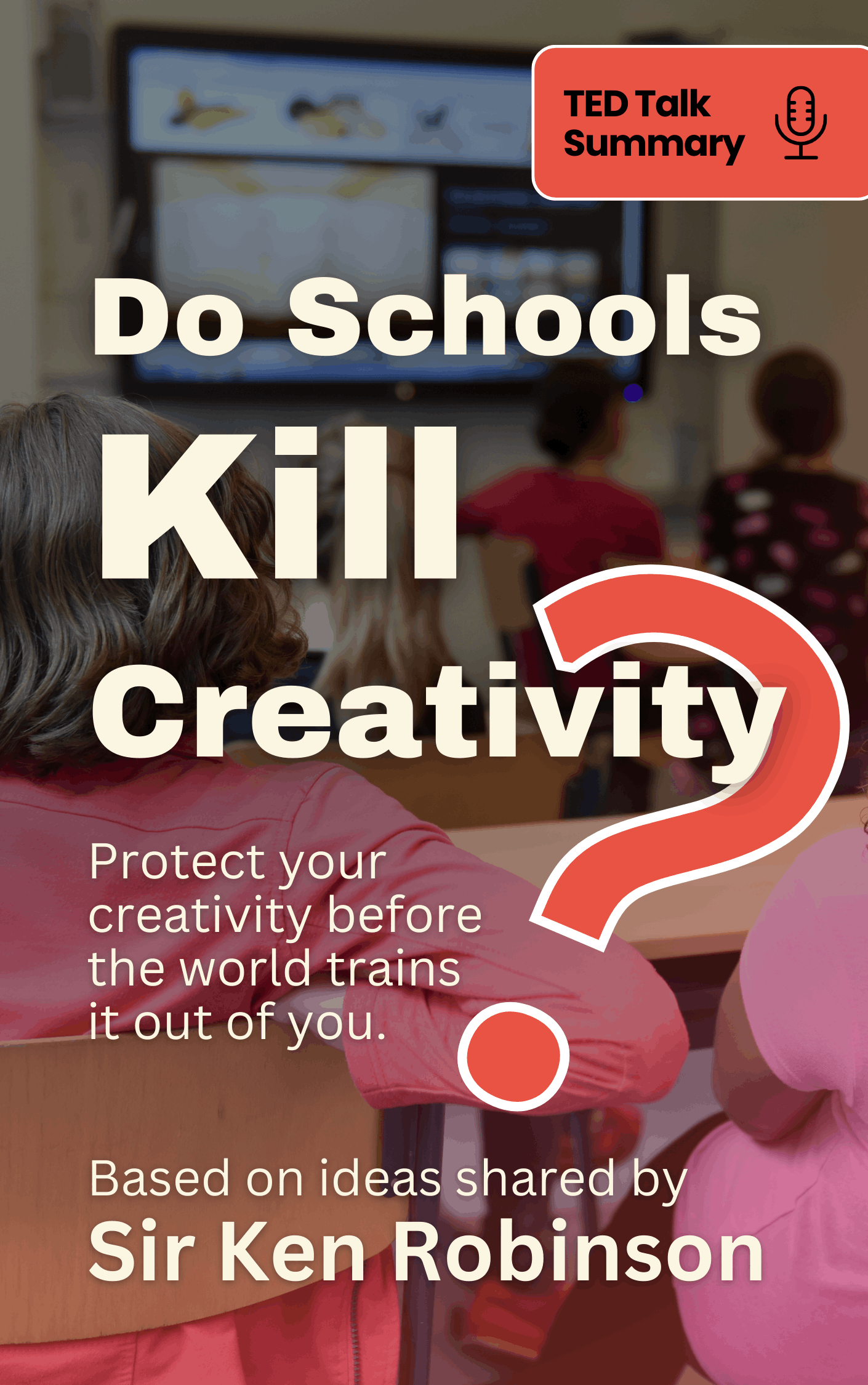
Most of us grow up believing creativity belongs to a lucky few—the artists, musicians, or “naturally gifted” people. Somewhere along the way, we quietly accept that being wrong is risky, that certain talents matter more than others, and that success follows a narrow academic path. This talk gently—and humorously—pulls apart those assumptions.
Through stories, observations, and sharp wit, the speaker invites us to question how education shapes not just what we know, but how we think about ourselves. The central idea is simple yet unsettling: while children are bursting with creative potential, the systems meant to prepare them for the future often suppress the very qualities they’ll need most. And if we’re not careful, we don’t just lose creativity in schools—we lose it in life.
Summary
This talk leaves you with a gentle but urgent message: creativity is not something you’re born with or without—it’s something that needs protection. The world ahead will demand imagination, flexibility, and courage, and those qualities are already present in us, often buried under years of conditioning.
By rethinking how we view intelligence, mistakes, and talent, we don’t just help children—we give ourselves permission to rediscover parts of who we are. Creativity isn’t lost. It’s waiting to be taken seriously again.
Being Wrong Isn’t a Failure—It’s the Starting Point
One of the most striking ideas in the talk is how naturally fearless children are about being wrong. Watch a child draw, sing, or invent a story, and you’ll notice something refreshing: they don’t hesitate. If they don’t know the answer, they’ll guess. If they’re unsure, they’ll try anyway.There’s a memorable story about a young girl confidently drawing a picture of God. When told that no one knows what God looks like, she replies, “They will in a minute.” It’s...
The Hidden Hierarchy That Shapes Our Lives
Across the world, education systems quietly agree on one thing: some subjects matter more than others. Mathematics and languages sit at the top, followed by humanities, while the arts—music, drama, dance—are pushed to the margins. Even within the arts, there’s a ranking. Painting and music are taken more seriously than movement or performance.This hierarchy sends a powerful message to students early on: intelligence looks a certain way. If you’re good with numbers or words, you’re “smart.” If you think with...
We Don’t Grow Out of Creativity—We’re Educated Out of It
There’s a powerful idea at the heart of the talk: creativity doesn’t fade naturally with age. It’s not something children lose because they grow up—it’s something they’re trained to set aside.The education system we know today was designed for a different era, shaped by the needs of industrial society. It valued standardisation, efficiency, and producing workers for predictable roles. In that context, creativity was risky. Uniformity was safer.But the future is no longer predictable. Children entering school today will retire...
Intelligence Is Bigger Than We Think
To rethink creativity, we first need to rethink intelligence. The talk challenges the idea that intelligence is a single scale measured by exams or degrees. Instead, it paints intelligence as rich, varied, and alive.Intelligence is diverse. Some people think visually, others through sound, movement, or emotion. It’s dynamic—ideas spark when different ways of thinking collide. And it’s deeply personal. Many people only discover their true talent later in life, often by accident, when they stumble into something that feels natural...
A New Way to Think About Human Potential
The talk closes with a broader reflection on the future. If we continue to narrow human ability to a single academic path, we risk wasting enormous potential—not just in schools, but in society as a whole.The speaker introduces the idea of “human ecology”: the belief that people, like ecosystems, thrive on diversity. Just as nature depends on many different forms of life, our world depends on many different kinds of thinkers, creators, and problem-solvers.Creativity isn’t a luxury for artists—it’s a...
More knowledge in less time
The Art of Community
Get the key ideas from nonfiction bestsellers in minutes, not hours.
Find your next read
Get book lists curated by experts and personalized recommendations.
Shortcasts
We’ve teamed up with podcast creators to bring you key insights from podcasts.
About the Author
Sir Ken Robinson (1950–2020) was a British author, speaker, and international advisor on education, renowned for promoting creativity, innovation, and human potential. Knighted in 2003, his 2006 TED talk, "Do Schools Kill Creativity," is among the most-watched in history, advocating for a shift from industrial-style education to personalized learning.
Thank you for registering with Storise.
Your journey with books and ideas begins now, anytime, anywhere.
You can now use your registered email to log in to the app.





















.png)