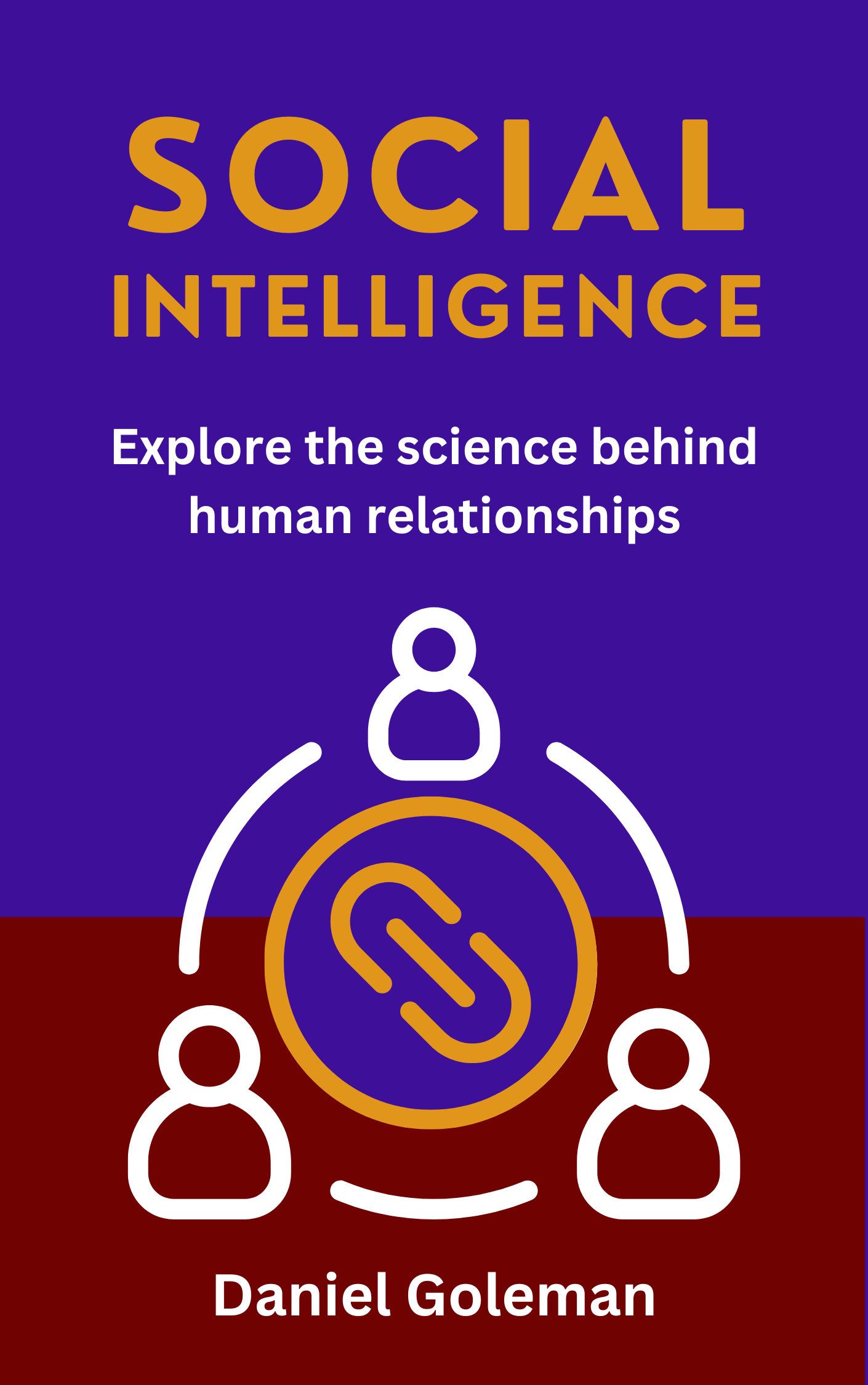
Social Intelligence: The New Science of Human Relationships
Summary of 6 key concepts
Audio & text inside the Storise experience
Introduction
Okay, let's do a little thought experiment here. Close your eyes and picture the last big family reunion you went to - tons of faces, everyone crowding around, playing catch up. And then there's that chatty aunt who just floats around from one conversation to the next, instantly bonding with whoever she talks to, before breezing on her merry way again.
You can't help but be impressed by her social finesse, right? Makes you wonder - what is going on inside her head as she works the room so effortlessly? How's she able to size people up and make connections on the spot like that? Enviable social grace! This talent goes by many names - social smarts, emotional IQ, and interpersonal intuition. However, psychologist and prolific author Daniel Goleman uses the term Social Intelligence. Social intelligence is the ability to understand one's own and others' actions. It is the ability to accurately detect emotions, understand implicit social dynamics, and respond to others with due regard to context which in turn helps build good personal, professional, and social connections.
Social intelligence is a whole different branch of intelligence, with its own set of concepts and all. For one, it’s not quantifiable in terms of IQ (intelligence quotient). We all know some high-IQ individuals who might be socially awkward, failing to carry even a simple conversation in a social setting. So, scoring well on IQ tests and other measures of book smarts has zero correlation with the ability to make friends, influence people, or handle workplace dynamics. And conversely, we all can name that social butterfly from high school who was no valedictorian but somehow has a huge circle of adoring friends and lands every promotion. The point is that we've got countless examples all around proving that healthy relationships so often flow from the intelligence of social grace (and not those aces).
And that, people, is why scientists are now hustling to catch up on studying social intelligence! So hey, stick around here to uncover more about why this sneaky talent proves so vital out in the real world.
Daniel Goleman is a psychologist and author who has written more than 300 books. He ranks among the top 10 influential business thinkers (The Wall Street Journal). His book Emotional Intelligence (1995) was a best seller in The New York Times for more than a year.
Social Intelligence: The New Science of Human Relationships (2006) combines neurobiology with psychology and explores how high social intelligence leads to happier people and healthier relationships. As Goleman explores, humans are wired to connect with and show empathy to one another. People with high social intelligence especially exhibit an ability to deeply comprehend others' perspectives and respond with care. Let’s dig deeper into that.
Summary
We are quintessential social beings who require a balanced degree of social intelligence to navigate successfully in our complex society, with its even more complex relationships. The book Social Intelligence by Daniel Goleman specifically explores the neurochemical aspects of social psychology. Tracing the evolutionary journey of our social intelligence and the part played by our neural wirings, the author shows how socially intelligent people are able to forge stronger bonds with each other and make lives a tiny bit easier!
People with a high degree of social intelligence display empathy!
Empathy is a term in trend. What do you think it actually means? We’ll give you a hint: Are you often told you are a good listener, or are you someone who quickly zones out of a conversation? One is an empath while the other is not. Figured it out, yet?Empathy is the ability to pay attention and pick up on emotional cues from people around you. An empath can put themselves in others’ shoes and feel their true feelings....
A healthy amount of fear/stress is good for nurturing social intelligence!
Stressed out lately? Well, turns out a healthy dash of anxiety ain't all bad! Not even for children. Social intelligence develops from experience with people and learning from successes and failures in social settings. On that note, meet Zoe! Zoe's parents were super overprotective - they basically bubble-wrapped the poor kid. And now, grown up, Zoe hates adventures, doesn't take risks, freaks out at the most minor problems, and still depends heavily on her parents. Zoe, unfortunately, exhibits low social...
The nature of our attachments and relationships can impact social intelligence, and vice versa
Remember where we started? Humans are wired to connect. We are built to form attachments. We also know experiences impact social intelligence; Zoe taught us that! Now what about relationships and attachments? Do experiences influence these? And do you think the nature of our childhood attachments shapes who we become?Well, to nobody's surprise, experiences do influence our attachment styles and these in turn do play a major role in influencing our social intelligence. Children who have secure, responsive attachments tend...
Navigating the High Road and Low Road to Social Intelligence
Has a random stranger ever made your day by coming to your aid when you were not even expecting help? Or, conversely, felt emotionally wounded by a thoughtless remark from someone close that ruined your whole week? Know what this tells you? Those interactions have the uncanny ability to influence our emotions, for better or worse. But why is that? We are wired to connect with people's moods, that's why! We simply can not exist in an emotional vacuum. Hence...
The Hidden Prescription - How Social Intelligence Cultivates Growth
Who said teachers only impact students' minds? The truly great ones know learning happens through hearts too. Just ask Pamela. She saw past one "troublemaker" to nurture the struggling soul beneath. Or chat with those Indian hospital staff ensuring patients are surrounded by supportive faces, not lonely trays. Turns out care and connection boost healing - who knew?Yet this powerful prescription often goes untouched. Why? Perhaps because emotional health remains a taboo. But what if unlocking academic potential or speeding...
Why Socially Intelligent Caregivers Need Support
Can you imagine being a full-time caregiver for your sick spouse or parent? It’s admirably selfless, no doubt. But as Janice Kiecolt-Glaser’s research shows, it can seriously jeopardize your own well-being. See, chronic stress affects us on a genetic level. It even hinders our immune system by reducing the activity of a molecule called GHmRNA, which produces infection-fighting lymphocytes and white blood cells. Their research proves just that: Alzheimer’s caregivers showed a drastic 50% drop in GHmRNA activity. It's no...
More knowledge in less time
The Art of Community
Get the key ideas from nonfiction bestsellers in minutes, not hours.
Find your next read
Get book lists curated by experts and personalized recommendations.
Shortcasts
We’ve teamed up with podcast creators to bring you key insights from podcasts.
About the Author
DANIEL GOLEMAN is the author of the international bestsellers Emotional Intelligence, Working with Emotional Intelligence, and Social Intelligence, and the co-author of the acclaimed business bestseller Primal Leadership. His latest books are What Makes a Leader: Why Emotional Intelligence Matters and The Triple Focus: A New Approach to Education. He was a science reporter for the New York Times, was twice nominated for the Pulitzer Prize, and received the American Psychological Association's Lifetime Achievement Award for his media writing. He lives in Massachusetts.
Similar titles like Social Intelligence: The New Science of Human Relationships
Thank you for registering with Storise.
Your journey with books and ideas begins now, anytime, anywhere.
You can now use your registered email to log in to the app.






















.png)