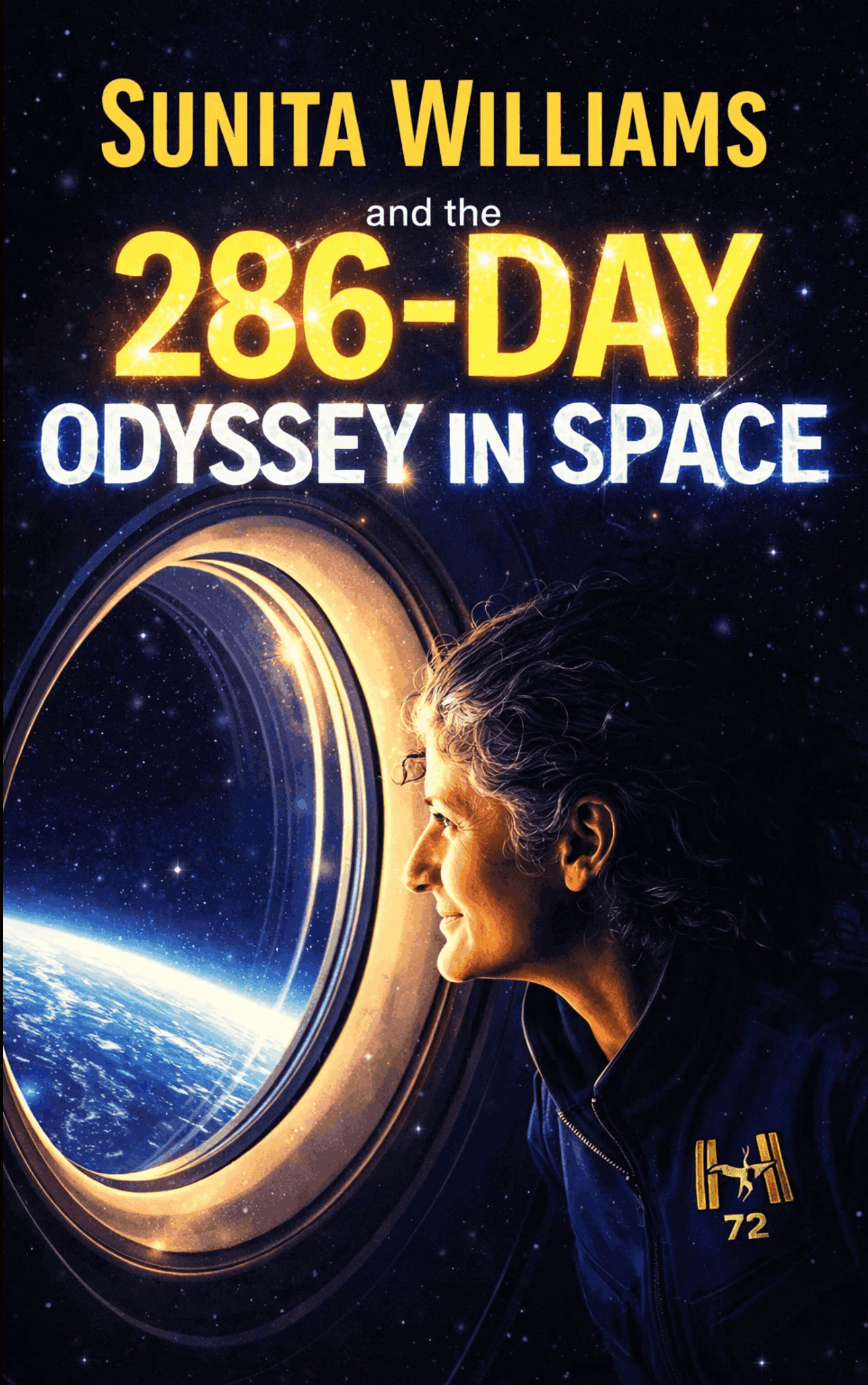
Resilience and perspective of Sunita Williams, an astronaut who turned an unexpected nine-month mission into a profound lesson in humanity. Moving beyond a simple timeline, these chapters delve into the sounds, smells, and psychological strength required to live amongst the stars when the path home becomes unpredictable. Curated by Storise Team based on ideas shared by Sunita Williams.
Sunita Williams did not set out to break records during her latest mission; she set out to test a new spacecraft. What was originally intended as a ten-day test flight transformed into a 286-day odyssey when the Boeing Starliner experienced thruster failures. Rather than seeing this as a catastrophe, Sunita viewed it as a reset of her expectations, a chance to continue the work she loves in a place she considers a second home. This is the story of how a girl who struggled with school exams became a commander of the International Space Station, proving that even when you are "stuck" 250 miles above Earth, you can still find ways to move forward.
What does it feel like when the quiet of space is suddenly broken by an emergency alarm?
Summary
The Humanity in the Stars
The most significant takeaway for Sunita Williams was not a technical discovery, but a realization about human goodness. While the news portrayed her as "stuck" or "stranded," she was overwhelmed by messages of support from people of all nationalities and religions who were praying for her safety. She concludes that humans are fundamentally kind and that much of our conflict on Earth is a distraction from our shared connection. Sunita insists she is not extraordinary, but simply someone who refused to take "no" for an answer, encouraging the next generation to realize that they, too, have the potential to reach for the stars.
The Midnight Safe Haven
In the middle of the night, silence on the space station is often a comfort, but one night it was shattered by a warning that a satellite below had exploded, creating a dangerous debris field. Sunita and her crewmates were forced into a "safe haven" procedure, retreating to their respective return vehicles in case the station was hit. In a moment that was both surreal and deeply human, the crew members met near the bathroom for a final check-in, sharing...
One Bite at a Time
When the Starliner thrusters began to fail, Sunita and her co-pilot Butch Wilmore were faced with a chaotic and unpredictable situation. Instead of panicking about the distance from home, Sunita utilised a technique called compartmentalisation, which she learned during her time as a military pilot. She describes problem-solving using the philosophy of "The Martian": you cannot tackle a giant crisis all at once, so you take one little bite at a time. By focusing only on the immediate goal of...
The Girl with the Wet Hair
Growing up in a multicultural Indian-Slovenian family, Sunita often felt like she stood out for the wrong reasons. She and her sister were the swimmers who arrived at school with wet hair and long Indian braids, feeling the discomfort of not quite blending in with their peers. Sunita is remarkably open about her insecurities, admitting that she struggled with academics in college and often doubted her ability to pass pilot check-rides or master complex robotic arms,,. However, she learned that...
A World Without Borders
From 250 miles up, national borders vanish into a singular, glowing map of human connection. Sunita observed city lights across various countries that looked like interconnected nerve centres, regardless of which territory they belonged to. During the day, she marveled at the massive wrinkles of the Himalayas, which appeared like giant folds where the Earth’s tectonic plates had bumped into each other millions of years ago. Even the oceans were alive with the lights of fishing boats on different coasts,...
Garlic, Dust, and Floating Tears
Life on the space station is a sensory experience unlike any on Earth. There is a constant background noise of pumps, fans, and the creaks and moans of metal expanding as it is heated by the sun,. Space smells like the people inside it and the food they eat; for Sunita, this meant the comforting scent of garlic and Indian food. Gravity’s absence changes everything, even emotions: when Sunita cried because she missed her dog, her tears did not fall...
In Memory of Pioneers
Sunita’s path to the stars was influenced heavily by her friend and role model, Kalpana Chawla. Following the Columbia tragedy, Sunita felt a deepened desire to explore more, believing that the best way to honour those who were lost was to press harder and continue their work. She views launch day not with a fear of death, but with the focused energy of a football player heading into a match, ready to take on the responsibility of the mission. To...
The Smell of Sage and a Simple Sandwich
Returning to Earth is a physical shock to the neurovestibular system, which essentially shuts down in space because it is not needed for balance. Upon landing, Sunita felt nauseous for nearly 24 hours as her inner ear relearned how to process gravity. Despite the physical toll, the return was a celebration of the senses: the smell of dirt and sage in the California desert and the luxury of feeling water fall during a real shower. Her first meal was a...
More knowledge in less time
The Art of Community
Get the key ideas from nonfiction bestsellers in minutes, not hours.
Find your next read
Get book lists curated by experts and personalized recommendations.
Shortcasts
We’ve teamed up with podcast creators to bring you key insights from podcasts.
About the Author
Sunita Williams is a renowned American astronaut and retired U.S. Navy Captain who set multiple records for women in space. Selected by NASA in 1998, she has flown on three major missions, totaling over 322 days in space, commanding the ISS, and completing 9 spacewalks (62+ hours).
Similar titles like Sunita Williams and the 286-Day Odyssey in Space
Thank you for registering with Storise.
Your journey with books and ideas begins now, anytime, anywhere.
You can now use your registered email to log in to the app.






















.png)