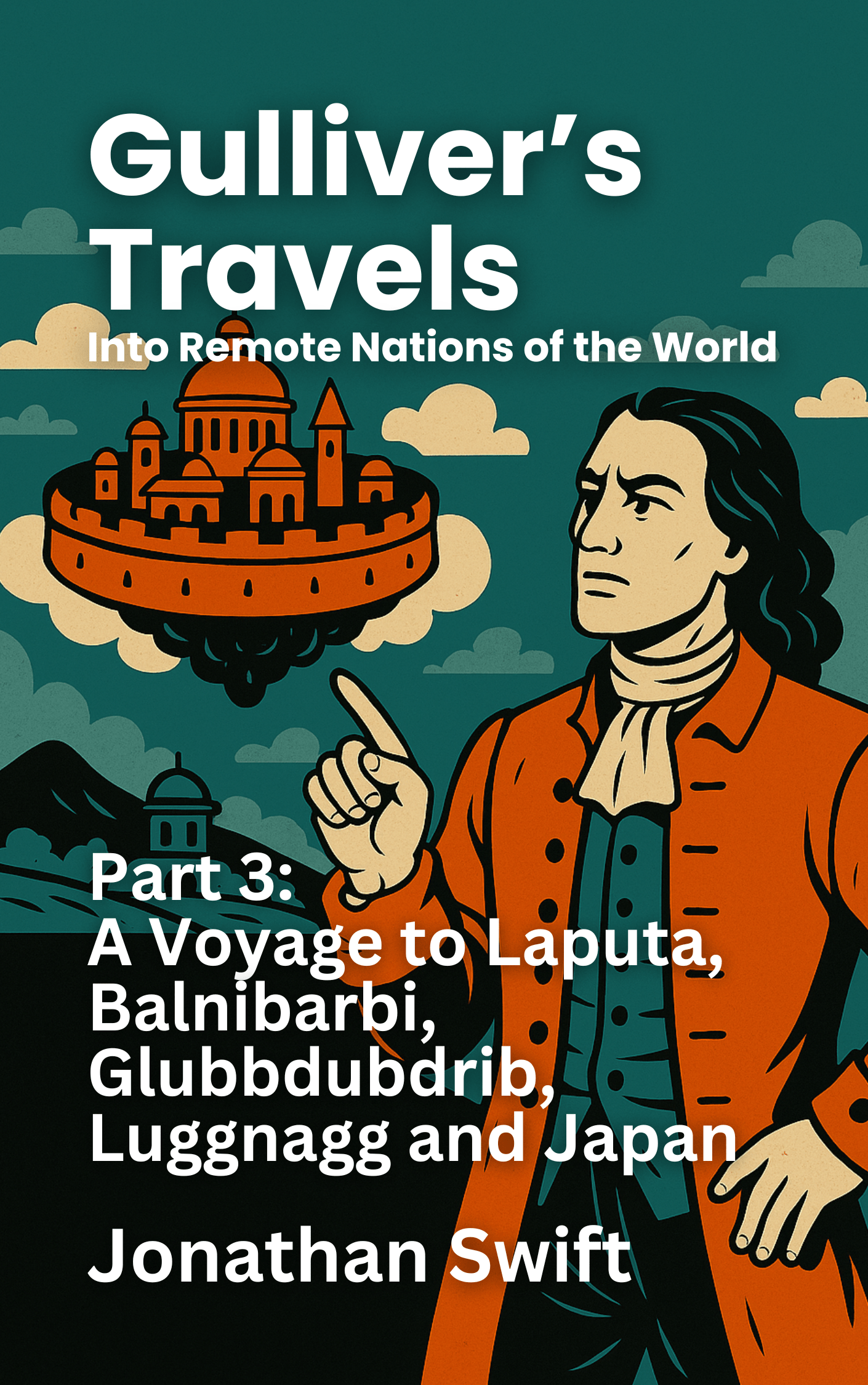
Gulliver's adventures take a turn from the physical to the intellectual. He visits Laputa, a floating island of eccentrically intellectual people obsessed with mathematics and music, and Balnibarbi, where an academy of scientists conducts bizarre and impractical experiments. He also encounters the immortal beings of Luggnagg, the philosophical ghosts of Glubbdubdrib, and the cunning but kind people of Japan.
Listen to audio
00:00
🔈Audio playback is not available on the web version. Please check on the mobile app.
The author sets out on his third voyage. Is taken by pirates. The malice of a Dutchman. His arrival at an island. He is received into Laputa.I had not been at home above ten days, when Captain William Robinson, a Cornish man, commander of the Hopewell, a stout ship of three hundred tons, came to my house. I had formerly been surgeon of another ship where he was master, and a fourth part owner, in a voyage to the Levant....
Chapter 2
The humours and dispositions of the Laputians described. An account of their learning. Of the king and his court. The author’s reception there. The inhabitants subject to fear and disquietudes. An account of the women.At my alighting, I was surrounded with a crowd of people, but those who stood nearest seemed to be of better quality. They beheld me with all the marks and circumstances of wonder; neither indeed was I much in their debt, having never till then seen...
Chapter 3
A phenomenon solved by modern philosophy and astronomy. The Laputians’ great improvements in the latter. The king’s method of suppressing insurrections.I desired leave of this prince to see the curiosities of the island, which he was graciously pleased to grant, and ordered my tutor to attend me. I chiefly wanted to know, to what cause, in art or in nature, it owed its several motions, whereof I will now give a philosophical account to the reader.The flying or floating island...
Chapter 4
The author leaves Laputa; is conveyed to Balnibarbi; arrives at the metropolis. A description of the metropolis, and the country adjoining. The author hospitably received by a great lord. His conversation with that lord.Although I cannot say that I was ill treated in this island, yet I must confess I thought myself too much neglected, not without some degree of contempt; for neither prince nor people appeared to be curious in any part of knowledge, except mathematics and music, wherein...
Chapter 5
The author permitted to see the grand academy of Lagado. The academy largely described. The arts wherein the professors employ themselves.This academy is not an entire single building, but a continuation of several houses on both sides of a street, which growing waste, was purchased and applied to that use.I was received very kindly by the warden, and went for many days to the academy. Every room has in it one or more projectors; and I believe I could not...
Chapter 6
A further account of the academy. The author proposes some improvements, which are honourably received.In the school of political projectors, I was but ill entertained; the professors appearing, in my judgment, wholly out of their senses, which is a scene that never fails to make me melancholy. These unhappy people were proposing schemes for persuading monarchs to choose favourites upon the score of their wisdom, capacity, and virtue; of teaching ministers to consult the public good; of rewarding merit, great...
Chapter 7
The author leaves Lagado: arrives at Maldonada. No ship ready. He takes a short voyage to Glubbdubdrib. His reception by the governor.The continent, of which this kingdom is a part, extends itself, as I have reason to believe, eastward, to that unknown tract of America westward of California; and north, to the Pacific Ocean, which is not above a hundred and fifty miles from Lagado; where there is a good port, and much commerce with the great island of Luggnagg,...
Chapter 8
A further account of Glubbdubdrib. Ancient and modern history corrected.Having a desire to see those ancients who were most renowned for wit and learning, I set apart one day on purpose. I proposed that Homer and Aristotle might appear at the head of all their commentators; but these were so numerous, that some hundreds were forced to attend in the court, and outward rooms of the palace. I knew, and could distinguish those two heroes, at first sight, not only...
Chapter 9
The author returns to Maldonada. Sails to the kingdom of Luggnagg. The author confined. He is sent for to court. The manner of his admittance. The king’s great lenity to his subjects.The day of our departure being come, I took leave of his highness, the Governor of Glubbdubdrib, and returned with my two companions to Maldonada, where, after a fortnight’s waiting, a ship was ready to sail for Luggnagg. The two gentlemen, and some others, were so generous and kind...
Chapter 10
The Luggnaggians commended. A particular description of the Struldbrugs, with many conversations between the author and some eminent persons upon that subject.The Luggnaggians are a polite and generous people; and although they are not without some share of that pride which is peculiar to all Eastern countries, yet they show themselves courteous to strangers, especially such who are countenanced by the court. I had many acquaintance, and among persons of the best fashion; and being always attended by my interpreter,...
Chapter 11
The author leaves Luggnagg, and sails to Japan. From thence he returns in a Dutch ship to Amsterdam, and from Amsterdam to England.I thought this account of the struldbrugs might be some entertainment to the reader, because it seems to be a little out of the common way; at least I do not remember to have met the like in any book of travels that has come to my hands; and if I am deceived, my excuse must be, that...
More knowledge in less time
The Art of Community
Get the key ideas from nonfiction bestsellers in minutes, not hours.
Find your next read
Get book lists curated by experts and personalized recommendations.
Shortcasts
We’ve teamed up with podcast creators to bring you key insights from podcasts.
About the Author
Jonathan Swift, was a renowned Anglo-Irish satirist, essayist, and clergyman. He is best known for his satirical masterpiece, Gulliver's Travels, and his biting social and political commentary, often published under pseudonyms.
More on: https://en.wikipedia.org/wiki/Jonathan_Swift
Thank you for registering with Storise.
Your journey with books and ideas begins now, anytime, anywhere.
You can now use your registered email to log in to the app.






















.png)