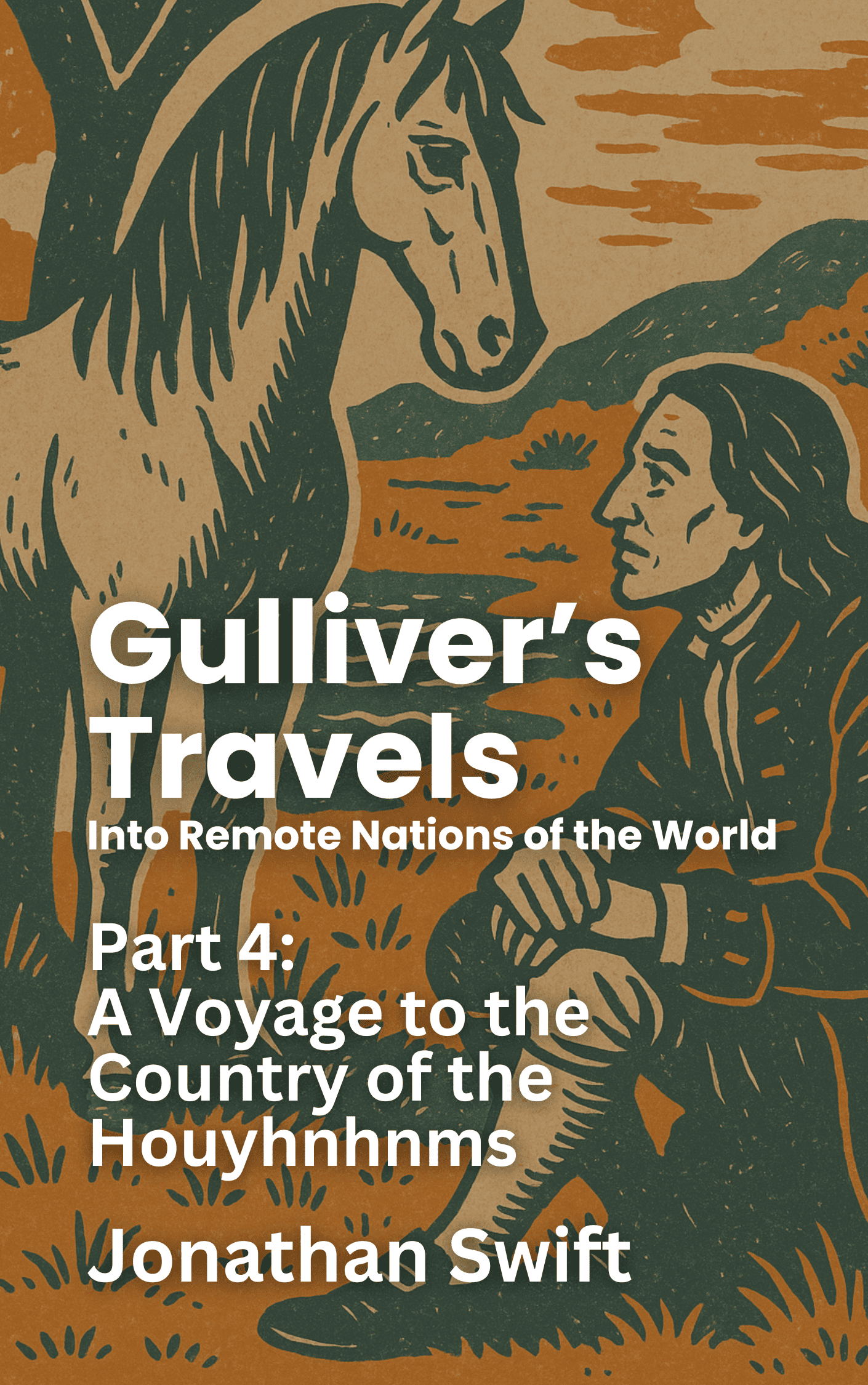
Gulliver is marooned on an island inhabited by intelligent horses called Houyhnhnms and brutish human-like creatures called Yahoos. Fascinated by the Houyhnhnms' rational society, Gulliver struggles to reconcile their virtue with the savage nature of the Yahoos, who are physically similar to himself.
Listen to audio
00:00
🔈Audio playback is not available on the web version. Please check on the mobile app.
The author sets out as captain of a ship. His men conspire against him, confine him a long time to his cabin, and set him on shore in an unknown land. He travels up into the country. The Yahoos, a strange sort of animal, described. The author meets two Houyhnhnms.I continued at home with my wife and children about five months in a very happy condition, if I could have learned the lesson of knowing when I was well. I...
Chapter 2
The author conducted by a Houyhnhnm to his house. The house described. The author’s reception. The food of the Houyhnhnms. The author in distress for want of meat, is at last relieved. His manner of feeding in this country.Having travelled about three miles, we came to a long kind of building, made of timber stuck in the ground, and wattled across; the roof was low and covered with straw. I now began to be a little comforted; and took out...
Chapter 3
The author studies to learn the language. The Houyhnhnm, his master, assists in teaching him. The language described. Several Houyhnhnms of quality come out of curiosity to see the author. He gives his master a short account of his voyage.My principal endeavour was to learn the language, which my master (for so I shall henceforth call him), and his children, and every servant of his house, were desirous to teach me; for they looked upon it as a prodigy, that...
Chapter 4
The Houyhnhnms’ notion of truth and falsehood. The author’s discourse disapproved by his master. The author gives a more particular account of himself, and the accidents of his voyage.My master heard me with great appearances of uneasiness in his countenance; because doubting, or not believing, are so little known in this country, that the inhabitants cannot tell how to behave themselves under such circumstances. And I remember, in frequent discourses with my master concerning the nature of manhood in other...
Chapter 5
The author at his master’s command, informs him of the state of England. The causes of war among the princes of Europe. The author begins to explain the English constitution.The reader may please to observe, that the following extract of many conversations I had with my master, contains a summary of the most material points which were discoursed at several times for above two years; his honour often desiring fuller satisfaction, as I farther improved in the Houyhnhnm tongue. I...
Chapter 6
A continuation of the state of England under Queen Anne. The character of a first minister of state in European courts.My master was yet wholly at a loss to understand what motives could incite this race of lawyers to perplex, disquiet, and weary themselves, and engage in a confederacy of injustice, merely for the sake of injuring their fellow-animals; neither could he comprehend what I meant in saying, they did it for hire. Whereupon I was at much pains to...
Chapter 7
The author’s great love of his native country. His master’s observations upon the constitution and administration of England, as described by the author, with parallel cases and comparisons. His master’s observations upon human nature.The reader may be disposed to wonder how I could prevail on myself to give so free a representation of my own species, among a race of mortals who are already too apt to conceive the vilest opinion of humankind, from that entire congruity between me and...
Chapter 8
The author relates several particulars of the Yahoos. The great virtues of the Houyhnhnms. The education and exercise of their youth. Their general assembly.As I ought to have understood human nature much better than I supposed it possible for my master to do, so it was easy to apply the character he gave of the Yahoos to myself and my countrymen; and I believed I could yet make further discoveries, from my own observation. I therefore often begged his honour...
Chapter 9
A grand debate at the general assembly of the Houyhnhnms, and how it was determined. The learning of the Houyhnhnms. Their buildings. Their manner of burials. The defectiveness of their language.One of these grand assemblies was held in my time, about three months before my departure, whither my master went as the representative of our district. In this council was resumed their old debate, and indeed the only debate that ever happened in their country; whereof my master, after his...
Chapter 10
The author’s economy, and happy life among the Houyhnhnms. His great improvement in virtue by conversing with them. Their conversations. The author has notice given him by his master, that he must depart from the country. He falls into a swoon for grief; but submits. He contrives and finishes a canoe by the help of a fellow-servant, and puts to sea at a venture.I had settled my little economy to my own heart’s content. My master had ordered a room...
Chapter 11
The author’s dangerous voyage. He arrives at New Holland, hoping to settle there. Is wounded with an arrow by one of the natives. Is seized and carried by force into a Portuguese ship. The great civilities of the captain. The author arrives at England.I began this desperate voyage on February 15, 1714–15, at nine o’clock in the morning. The wind was very favourable; however, I made use at first only of my paddles; but considering I should soon be weary,...
Chapter 12
The author’s veracity. His design in publishing this work. His censure of those travellers who swerve from the truth. The author clears himself from any sinister ends in writing. An objection answered. The method of planting colonies. His native country commended. The right of the crown to those countries described by the author is justified. The difficulty of conquering them. The author takes his last leave of the reader; proposes his manner of living for the future; gives good advice,...
More knowledge in less time
The Art of Community
Get the key ideas from nonfiction bestsellers in minutes, not hours.
Find your next read
Get book lists curated by experts and personalized recommendations.
Shortcasts
We’ve teamed up with podcast creators to bring you key insights from podcasts.
About the Author
Jonathan Swift, was a renowned Anglo-Irish satirist, essayist, and clergyman. He is best known for his satirical masterpiece, Gulliver's Travels, and his biting social and political commentary, often published under pseudonyms.
More on: https://en.wikipedia.org/wiki/Jonathan_Swift
Thank you for registering with Storise.
Your journey with books and ideas begins now, anytime, anywhere.
You can now use your registered email to log in to the app.






















.png)