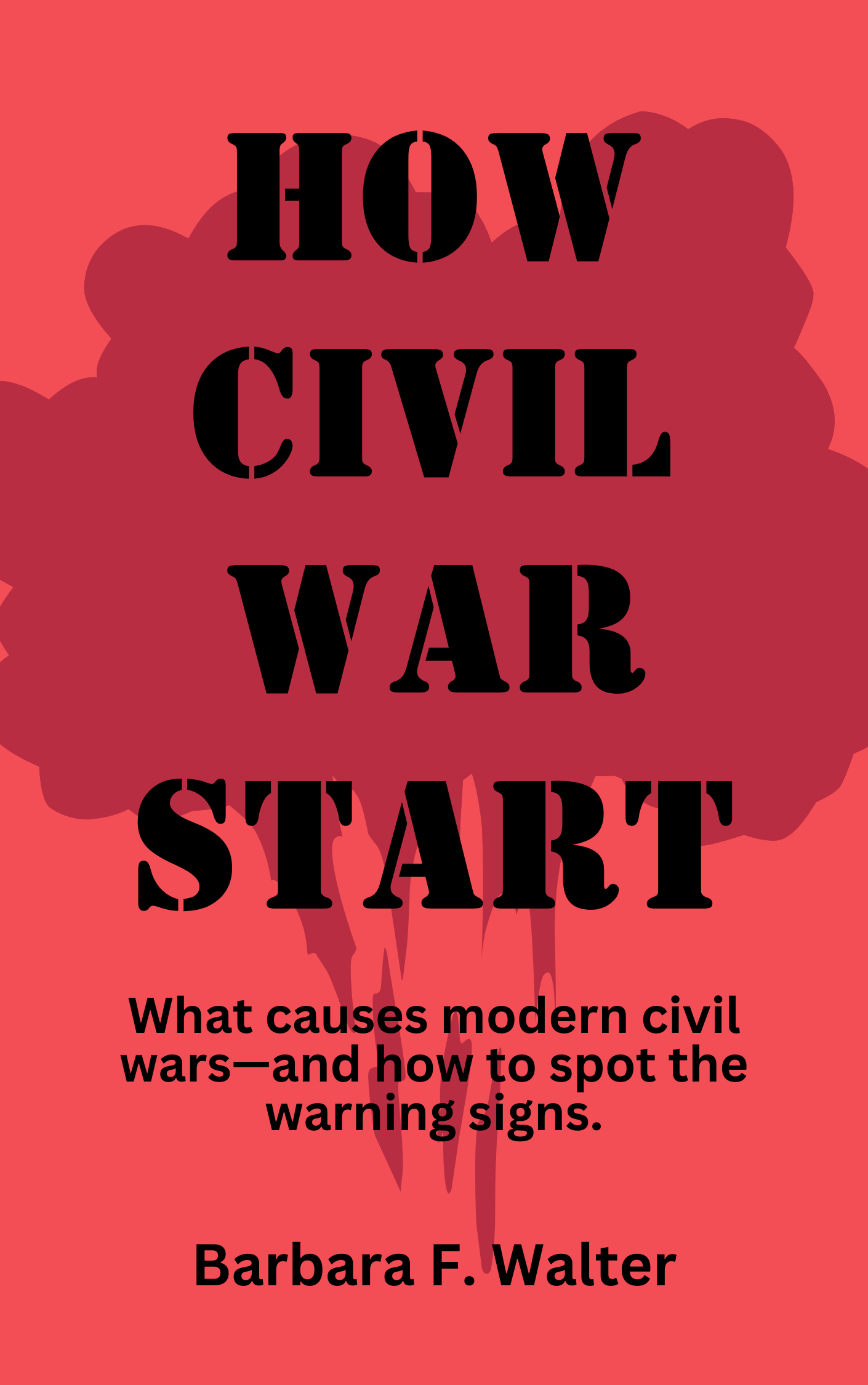
Civil wars aren’t relics of the past or distant headlines—they can happen in thriving democracies, often without warning. In How Civil Wars Start, political scientist Barbara F. Walter draws from decades of research and global case studies to explain how once-stable societies descend into violent conflict. What makes her analysis chilling is that it’s not about failed states but those that are failing from the inside out. With a sharp focus on patterns, triggers, and overlooked danger signs, the book is less about history and more a wake-up call for the present—especially for countries like the United States.
So what exactly do the warning signs look like? Let's see.
Summary
Civil wars don’t erupt in a vacuum. They begin with warning signs—political instability, identity-based division, eroding trust, and rising militancy. The good news is that by recognizing these signs early, societies can still change course. The challenge is choosing to act before it's too late. Stability isn’t automatic. It’s something we all have to protect.
The Warning Light Few Notice: Anocracy
Civil wars rarely begin in the chaos of complete authoritarianism or the order of full democracies. Instead, they ignite in the in-between—what political scientists call anocracy. It’s a transitional form of government, stuck between dictatorship and democracy. These are the places where leaders might still hold elections but bend the rules to stay in power. Citizens might speak freely, but only up to a point. There’s just enough openness to raise public expectations, but not enough structure or fairness to...
Identity Politics Is Toxic
In healthy societies, people see themselves first as citizens—bound by shared rights, laws, and a collective future. But when politics shifts from ideas to identities, something dangerous happens. People stop voting based on what they believe and start voting based on who they are. Ethnic group, religion, language, or race becomes the dividing line. And when identity becomes the battleground, losing an election isn’t just disappointing—it feels like a threat to your entire existence.This shift doesn’t happen overnight, either. It...
When Institutions Fail
No government is perfect, but in functioning democracies, institutions act as safety nets. Courts settle disputes fairly, elections are respected, and the media keeps power in check. These systems don’t eliminate conflict, but they contain it. They provide peaceful outlets for frustration. However, when these institutions begin to fail—or appear rigged—the consequences can be explosive.The collapse of institutional trust doesn’t usually happen in a single event. It’s a slow erosion. Maybe it begins with a controversial court ruling, followed by...
Your Narrative Becomes The Weapon
In times of uncertainty, people turn to stories to make sense of what’s happening. But not all stories are harmless. In divided societies, the most powerful narratives are often the most dangerous. They don’t just describe the world—they shape it. And when these narratives are built on fear, conspiracy, and grievance, they can push ordinary people toward extraordinary acts.Narratives like “our way of life is under attack” or “they’re trying to replace us” aren’t based on fact—they’re built to incite...
Private Armies, Public Risks
In a functioning society, the state holds a monopoly on force. The police, the military, the courts—these institutions are meant to maintain order and protect rights. But when trust in those institutions breaks down, a new kind of actor emerges: the militia. These groups claim to offer protection, but more often, they become catalysts for chaos.Militias don’t form out of nowhere. They usually emerge when people feel abandoned or threatened. Maybe they believe the government isn’t defending their community. Maybe...
The Role of Political Entrepreneurs
Civil wars don’t happen by accident. More often than not, someone lights the match. These instigators are political entrepreneurs—individuals who see opportunity in division and profit in instability. They don’t need a majority. All they need is a loud, loyal following and a narrative that catches fire.These figures often present themselves as outsiders or saviors. They claim the system is broken and only they can fix it. But their real strategy is to inflame grievances, undermine democratic norms, and concentrate...
Close to the Edge
The most unsettling truth about modern civil wars is how silently they begin. There are rarely tanks in the streets or battle lines drawn overnight. Instead, they creep in—disguised as political disputes, regional grievances, and social unrest. And then, one day, the country wakes up to find itself at war—not between nations, but within neighborhoods.Walter’s research shows that civil wars don’t typically erupt in the world’s poorest nations or the most chaotic autocracies. Instead, they most often emerge in what...
More knowledge in less time
The Art of Community
Get the key ideas from nonfiction bestsellers in minutes, not hours.
Find your next read
Get book lists curated by experts and personalized recommendations.
Shortcasts
We’ve teamed up with podcast creators to bring you key insights from podcasts.
About the Author
Barbara F. Walter is one of the world's leading experts on civil wars, violent extremism and domestic terrorism. She is the author of five books and dozens of articles on these subjects and is a frequent live guest on CNN, MSNBC and PBS. Walter has written for the New Yorker, the New York Times, the Washington Post, the Wall Street Journal, the Los Angeles Times, Time, the New Republic, and Foreign Affairs. She has also consulted for the World Bank, the Departments of Defense and State, the United Nations, and the January 6th Committee.
Thank you for registering with Storise.
Your journey with books and ideas begins now, anytime, anywhere.
You can now use your registered email to log in to the app.






















.png)