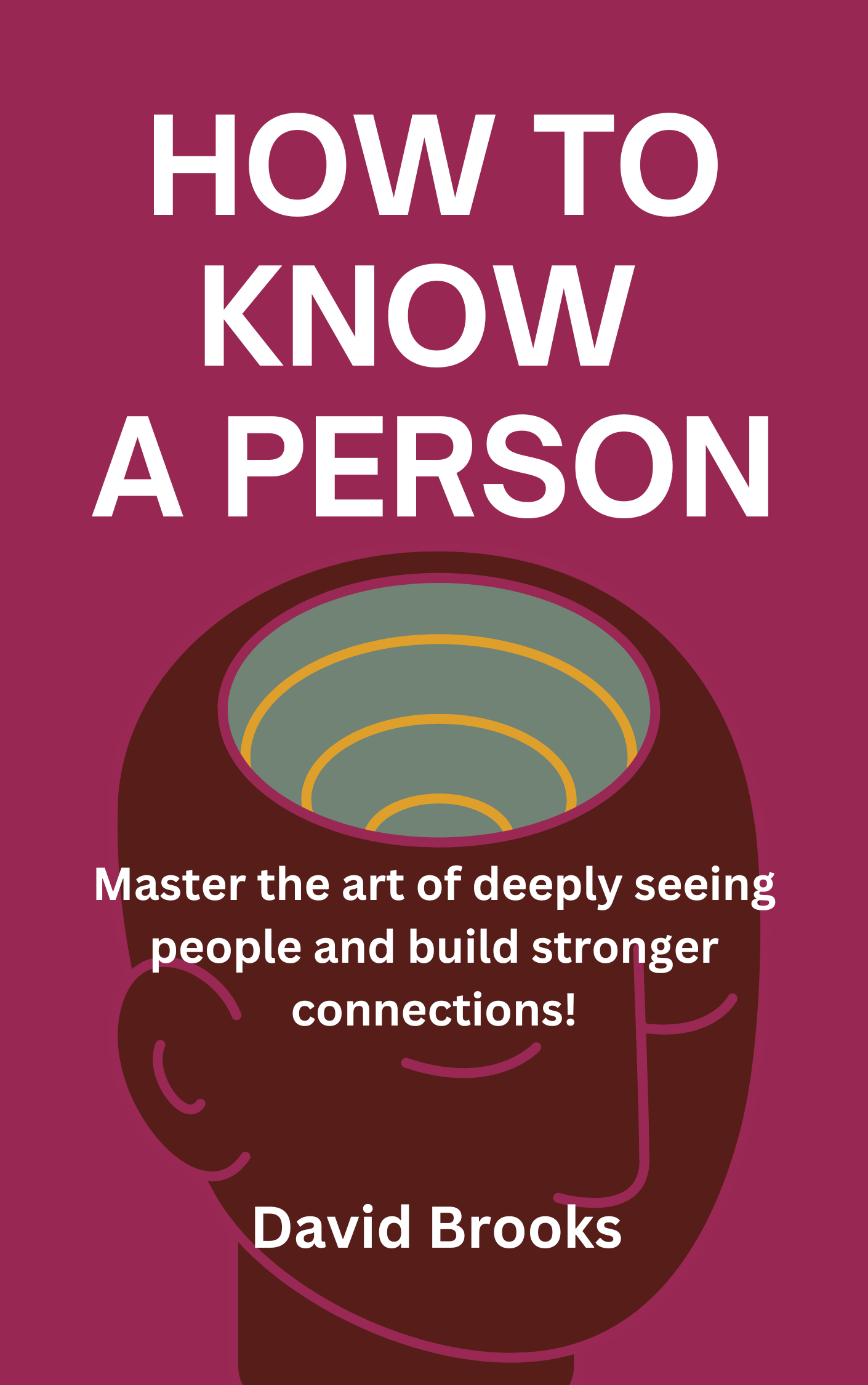
We interact with lots of people everyday. But, how many of them do we really care enough about, to want to know them deeply? When was the last time, you undertook a long, respectful conversation with someone you disagreed with? Most of us are caught in superficialities like attire or formal mannerisms when we encounter someone. David Brooks believes that the foundation of a healthy society and community rests on our ability to see others deeply and also be deeply seen by others. Our capability to forge meaningful, warm and stronger bonds with each other is the hallmark of our social fabric.
But today, an individual in society is becoming more isolated than ever before! How to Know a Person: The Art of Seeing Others Deeply and Being Deeply Seen (2023) by David Brooks addresses issues of loneliness and isolation and shows us how to forge deeper and more meaningful relationships, promoting empathy and understanding in today’s fragmented society.
Brooks writes for The New York Times, and The Atlantic, and works as a commentator on PBS NewsHour. He is a recognised political and cultural commentator and has authored best-selling books like The Second Mountain(2019), The Road to Character (2015), and The Social Animal (2011).
Summary
How to Know a Person by David Brooks is a perfect read for people who wish to see others deeply and also want to be seen. The fragmented and divisive world where we live creates an increasingly isolated human being. The author believes in the power of good conversations and suggests healthy interactions as a way to forge authentic and deep bonds with everyone. Brooks suggests that we need to look past our perspectives, upbringing and beliefs if we wish to see people for who they really are. Each person is a unique entity and deserves to be loved, appreciated and seen so that there's balance and harmony in society.
The Need To See Others Deeply And Be Seen!
The need to be seen by others and truly see others is the purest essence of humanity. Man, a social animal, is not meant to lead a life in isolation. Growing up in a reserved Jewish household, Brooks saw an emotionally detached upbringing and pursued comfort in solitary activities like writing. It was much later in life when he realised his resultant inability to express love and care openly and how it impacted his core relations. A series of broken...
Be An Illuminator In A World Filled With Diminishers!
A diminisher is someone who makes you feel unseen and unimportant. Think about the self-absorbed ex who never wanted to know how your day went and was more concerned about their self-obsessive agenda. As opposed to a diminisher, an illuminator is someone who gives adequate attention to everyone he/she encounters. An illuminator displays exceptional sensitivity towards people’s moods and is actively curious about others. We all have that old kind neighbour who always asks the right questions of us. Or...
The Ability To Hold A Conversation Is A Gift!
We love to have small conversations with people we meet at a bus stop or a supermarket. Occasionally, we might enjoy a friendly banter with a neighbour. But small talk does not have to be meaningless chatter or just an exchange of pleasantries. An interaction can also be an opportunity to hold a meaningful conversation; a two-way exchange which can create mutual understanding, paving the way towards a deep, longer conversation.Remember, being good at conversing does not mean being a...
Don't Shy Away From The Hard Conversations!
Ever wondered where we stand as a society when it comes to real connections? Well, we are in deep trouble if we take a look at surging suicide rates and rising social isolation. Do you know that there has been a 33% increase in suicide rates in America from 1999 to 2019? What could be the reason? Maybe technological dehumanisation? Or the ever-increasing political animosities? Or the fact that we feel more connected to strangers online, than real-life people?While we...
It Is All About Understanding Multiple Perspectives!
Do you love to converse with people who share your perspective on life? It's easy to forge a connection with them. But, completely agreeing and sharing perspectives is rare! So, at one point or another, you’ll find yourself in conversation with someone who has a completely different perspective. And it will be tough to hold a conversation with them! But it’s not impossible.See, our unique perspectives are a result of our cultural setup, personal experiences, beliefs, traumas, etc. So, an...
Develop empathy and be present for your loved ones!
Is it too late to save someone teethering on the verge? Sometimes, life teaches the lesson the hard way! David Brooks' life changed when his close friend Pete, a man known for a sunny temperament, suddenly ended his life. The author could not believe that a person who seemed to be happy would take such a step. Brooks realised that helping a person who is in a depressive state of mind requires extra effort. Putting energy into trying to cheer...
More knowledge in less time
The Art of Community
Get the key ideas from nonfiction bestsellers in minutes, not hours.
Find your next read
Get book lists curated by experts and personalized recommendations.
Shortcasts
We’ve teamed up with podcast creators to bring you key insights from podcasts.
About the Author
David Brooks is a Canadian-born American conservative political and cultural commentator who writes for The New York Times. He has worked as a film critic for The Washington Times, a reporter and later op-ed editor for The Wall Street Journal, a senior editor at The Weekly Standard from its inception, a contributing editor at Newsweek, and The Atlantic Monthly, in addition to working as a commentator on NPR and the PBS NewsHour.
More on: https://en.wikipedia.org/wiki/David_Brooks_(commentator)
Thank you for registering with Storise.
Your journey with books and ideas begins now, anytime, anywhere.
You can now use your registered email to log in to the app.






















.png)