The mysteries of the human brain have always intrigued researchers and psychologists. The enigmatic realm of human cognition continues to captivate our attention.
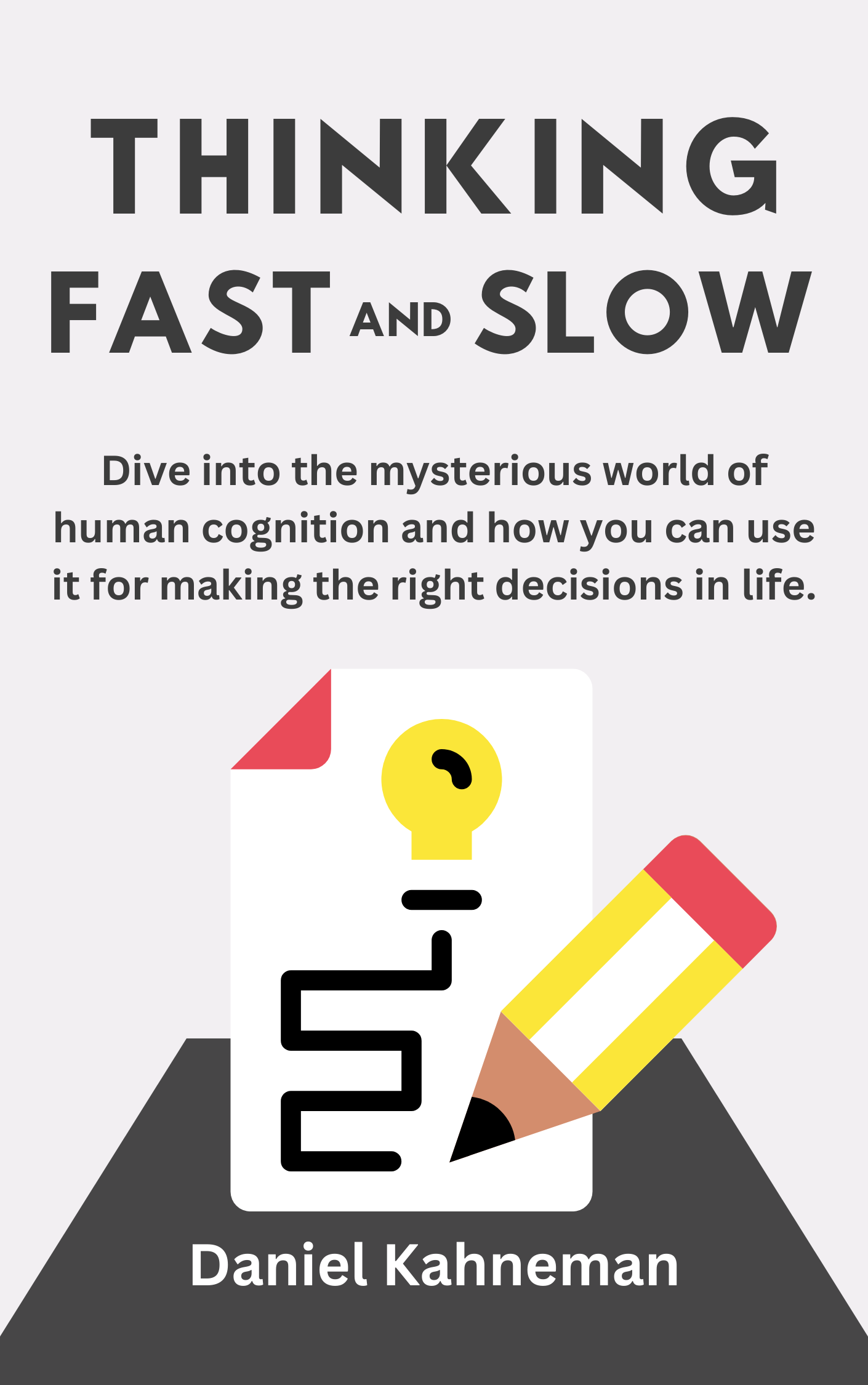
In "Thinking, Fast and Slow", a renowned psychologist, and Nobel laureate, Daniel Kahneman explores the two distinct systems that govern our thinking processes. Drawing on decades of research, Daniel Kahneman explains that our minds have two systems of thinking. System 1 is fast, automatic, and intuitive. Our ancestors needed to be fast to avoid predators. This system was a product of their learned experience and adaptation. And System 2 - slow, deliberate, and analytical. Imagine trying to find your best friend in a massive crowd at a stadium. If you keep yourself focused on certain characteristics/features to look out for like their hair color, height, and clothes, and keep struggling to find them, you’ll be more likely to spot them, But if you get distracted by the game, the noise, and each person in the crowd, start glossing over their details - who they are, how they look, etc. it’ll be very hard to spot her. This is what System 2 does. It allows you to focus and removes distractions
System 1 operates quickly and effortlessly, relying on mental shortcuts and patterns to make decisions. Imagine you're driving a car, and suddenly, the vehicle in front of you slams on its brakes. Without conscious thought, your foot instinctively moves to the brake pedal. This swift reaction is an example of System 1 thinking, where your brain relies on automatic reflexes and pattern recognition to respond rapidly to a familiar situation. In contrast, System 2 is more effortful and requires conscious effort and concentration. Consider the process of solving a complex math problem or unraveling a challenging riddle. It requires focused concentration and deliberate mental effort. This deliberate engagement of your cognitive abilities represents System 2 thinking, where you consciously engage in analytical reasoning to arrive at a solution.
Kahneman explains the powerful influence of these two thinking systems on various aspects of our lives, from personal relationships to economic behavior.
Let’s dive deeper into the impacts of these two systems in our daily lives.
Summary
"Thinking, Fast and Slow" is a groundbreaking book by Daniel Kahneman that delves into the two systems that govern our thought processes. System 1 operates automatically and effortlessly, relying on intuition and emotions to make quick decisions. System 2 is deliberate and logical, requiring effort to process complex information. Kahneman explores how these systems shape our judgments, biases, and behaviors, leading to cognitive errors and irrationality. He introduces various cognitive biases, such as the availability heuristic and anchoring effect, that influence our perceptions and decision-making. The book also introduces prospect theory, which explains how people value potential gains and losses differently. Overall, "Thinking, Fast and Slow" offers profound insights into human psychology, challenging our understanding of rationality and providing valuable lessons on how to make more informed choices.
The Impact of Laziness: Decision-Making and Intelligence
Laziness is deeply ingrained in our nature. In cognitive processes, laziness refers to our mind's preference for relying on System 1, the fast and automatic thinking mode, even in situations that demand the thorough analysis of System 2, the slower and more deliberate thinking mode. Workings of System 1 primarily give rise to Cognitive biases, which often rely on heuristics: mental shortcuts our brain uses to make decisions based on easily accessible information. System one usually comes to give you...
Priming and the Unconscious Influence on Our Thoughts and Actions
Our lack of constant conscious control over our thoughts and actions can be attributed to the prevalence of System 1 (rapid thinking), which frequently assumes command and influences our conduct without our awareness. This can result in swift, intuition-driven judgments, sometimes bypassing the need for more deliberate reflection. Your responses to a situation will consequently be based on your existing thoughts and knowledge and you will use them to fill in the blanks and respond accordingly. This process is known...
Making quick but defective choices: The Halo Effect
Other instances where System 1 takes over are the halo effect and confirmation bias. Imagine you like one thing about a person, let's say, Andrew, whom you met at the shops but don’t know too much about. Just because you like one aspect, then you presume that everything else about him is positive. So when you’re in trouble you will first think of Andrew because of the image you have created in your mind of him. This acts as if...
Cognitive Shortcuts: Unveiling the Mind's Quick Decision-Making Tools
In various situations, our minds use shortcuts called heuristics to quickly understand our surroundings. Although heuristics are usually helpful, overreliance on them can lead to mistakes in many situations & make quick decisions. Two types of heuristics relevant to us are the substitution heuristic and the availability heuristic.The substitution heuristic is when our mind answers an easier question instead of the one that was actually posed. An example of the substitution heuristic is when people are asked to rate their...
Numerical Navigations: How Our Difficulty with Statistics Leads to Mistakes We Could Avoid
Our challenges in comprehending statistics and committing avoidable errors arise because our intuitive thinking system (System 1) often relies on mental shortcuts (heuristics) and biases, especially when dealing with intricate statistical data that demands the involvement of our more deliberate thinking system (System 2). An illustrative study by Amos Tversky and Daniel Kahneman delves into the anchoring effect. In this study, participants were tasked with estimating the percentage of African countries in the United Nations. Before providing their estimates, they...
Hindsight Bias: How We Remember Events Differently.
Our minds have two memory selves – the experiencing self and the remembering self. The experiencing self records how we feel in the moment, giving an accurate account of the experience. On the other hand, the remembering self recalls the whole event afterward, but it is less accurate since it registers memories after the event is over. Two reasons contribute to this: duration neglect, where we ignore the total duration of the event and focus on specific memories, and the...
Shifting Mental Focus Shapes Thoughts and Actions.
Adjusting the focus of our minds can significantly impact our thoughts and behaviors. Shifting our attention and perspective can lead to different interpretations and decisions. For instance, focusing on the present moment may influence our immediate emotional responses, while contemplating the long-term consequences can lead to more rational and considered choices. An experiment involving a group of judges showed that their decisions on whether to grant parole to prisoners were significantly influenced by the time of day. As the judges...
The Probability Puzzle: How Presentation Shapes Our Decision-Making
The way we assess situations and handle challenges is heavily impacted by how they are presented to us. Even minor alterations in the wording or emphasis of a statement or question can have a significant influence on our approach.Let’s take an example. In a decision-making scenario, participants were given two investment options. The first investment was portrayed as having a 90% chance of yielding positive returns, while the second was described as having a 10% chance of resulting in losses....
Human Decision-Makers: Why Rational Thinking Alone Doesn't Guide Our Choices.
According to utility theory, we make choices to maximize our happiness or satisfaction. The Chicago School of Economics, led by Milton Friedman, called us "Econs" and believed we were super-rational decision-makers. They thought we valued things based on how much happiness they gave us, trying to get the most satisfaction from our choices. If a soccer ball and basketball cost $0, but you’re a crazy soccer fan, you’d go for the soccer ball. But utility theory doesn’t always hold.Enter the...
More knowledge in less time
The Art of Community
Get the key ideas from nonfiction bestsellers in minutes, not hours.
Find your next read
Get book lists curated by experts and personalized recommendations.
Shortcasts
We’ve teamed up with podcast creators to bring you key insights from podcasts.
About the Author
Daniel Kahneman is an Israeli-American psychologist notable for his work on the psychology of judgment and decision-making, as well as behavioral economics, for which he was awarded the 2002 Nobel Memorial Prize in Economic Sciences (shared with Vernon L. Smith). His empirical findings challenge the assumption of human rationality prevailing in modern economic theory. With Amos Tversky and others, Kahneman established a cognitive basis for common human errors that arise from heuristics and biases (Kahneman & Tversky, 1973; Kahneman, Slovic & Tversky, 1982; Tversky & Kahneman, 1974), and developed prospect theory (Kahneman & Tversky, 1979).
In 2011, he was named by Foreign Policy magazine to its list of top global thinkers. In the same year, his book Thinking, Fast and Slow, which summarizes much of his research, was published and became a best seller. He is professor emeritus of psychology and public affairs at Princeton University's Woodrow Wilson School. Kahneman is a founding partner of TGG Group, a business and philanthropy consulting company. He is married to Royal Society Fellow Anne Treisman.
In 2015 The Economist listed him as the seventh most influential economist in the world.
Thank you for registering with Storise.
Your journey with books and ideas begins now, anytime, anywhere.
You can now use your registered email to log in to the app.






















.png)