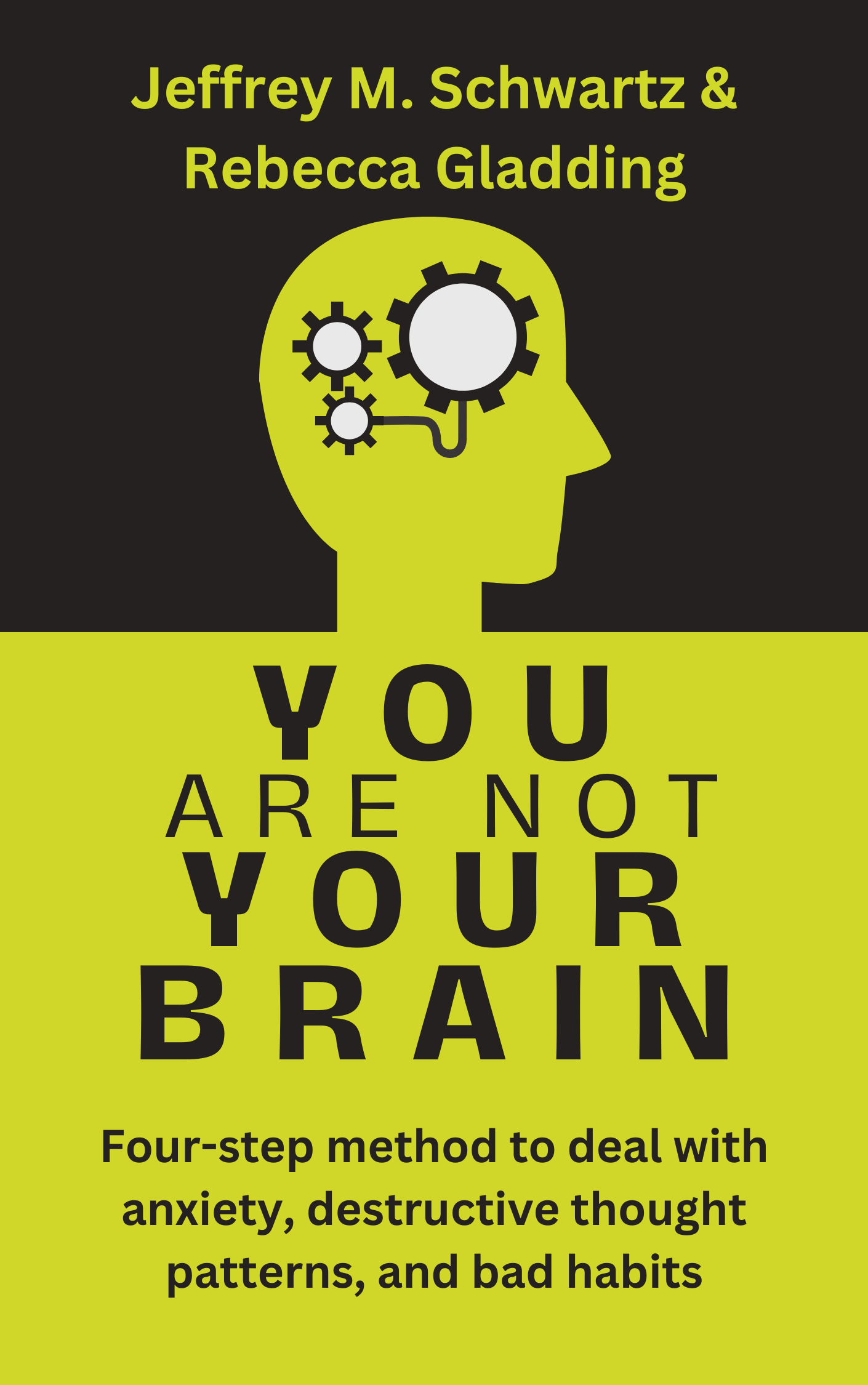
Do you often feel an onslaught of intrusive thoughts or anxiety? Do you listen to your brain when it tells you that ‘you are not good enough’ or ‘you do not deserve happiness’? What if we tell you that these thoughts do not define you? Won’t believe us? How about if a doctor says this? The authors Gladding and Schwartz are trained medical doctors with years of expertise and they assert that these negative thoughts are basically deceptive messages sent by your brain, shaped by its neural wiring. The good news is that this wiring can be altered! Yay.
In their groundbreaking book, Schwartz and Gladding offer a four-step solution to help readers recognize and disengage with these dark thoughts and deceptive brain messages, get rid of unhealthy thought patterns, and embrace healthy habits. With relabeling, reframing, refocusing, and revaluing deceptive brain messages, you overcome neural pathways that distort reality and embrace healthier thinking. This scientific approach gives hope to those struggling with anxiety, low self-worth, or other distressing, recurring thoughts.
Before getting to those glorious 4 steps, let’s first clear up some key concepts. First up, understanding the deal with deceptive messages.
Summary
You Are Not Your Brain: The 4-Step Solution for Changing Bad Habits, Ending Unhealthy Thinking, and Taking Control of Your Life by Jeffrey M. Schwartz and Rebecca Gladding combines cognitive behavioral therapy, neuroscience, and mindfulness to give you the Four-Step method. The Four-Step method of relabeling, reframing, refocusing, and revaluing will help you create healthy and adaptive brain circuits that transform the quality of your life.
Your Brain’s Deceptive Messages Are Not Reality: You Can Learn To Overcome Them
Our mind loves to wander, often to dark place of negative thoughts, wacky impulses, anxiety, and stress. Research in neuroscience shows that these negative thoughts are nothing but deceptive brain messages that create destructive habits hampering our growth and blocking our march towards our life goals leaving us feeling unfulfilled.And Even successful people face this! The authors give the example of one of their clients, a Broadway performer, to illustrate this. This gifted performer led a successful life from the...
Your Coping Behaviors May Be Encouraging the Deceptive Brain Messages
Deceptive messages set off actual, distressing physical sensations and emotions - as if the lies are 100% real! In return, we find coping mechanisms to deal with them. Take the "I'm too fat" thoughts. For some, that sparks extreme urges to over-diet or purge. Literally driving them into harmful patterns that wreck their health and self-worth.Or there are other, equally damaging, coping mechanisms. Like ‘feeding the monster’. Let's explain it this way. For example, let's say your brain tells you...
Self-Directed Neuroplasticity Is An Easy Answer To Reclaim Your Mind And Change Your Life!
Let’s simplify the word first. ‘Neuro’ is ‘neurons’ and ‘plasticity’ means the ‘quality of being easily molded’. So, self-directed neuroplasticity means that you yourself can direct your brain to alter its synaptic pathways and rewire the neural circuit. In other words, you can control the brain’s innate ability to create and change its neural connections.Let’s take a simple example here. Morning walk. For the first few days when the morning alarm goes off, you probably go back to sleep. However,...
The Four-Step Methodology Explained!
Rewiring your brain! Sounds technical and complicated. But, it’s not! Just understand and follow the Four-Step method, and you’ll change your biology and your life! We’ll make it simple. The Four-Step methodology is, conveniently, based on 4 R’s - relabel, reframe, refocus, and revalue. They help you break bad habit circuits and build good ones instead.Before we get to those in detail, we must first introduce two more concepts related to neuroplasticity. The first one is ‘Hebb’s Law’. What you...
Step 1 – Relabel
The key to initiating relabeling is mindfulness. It’s the foundation of all four steps, if you really look at it. Mindfulness is paying attention, on purpose, to the present moment without judgment. Remember, mindfulness is not just a state of mind. Being mindful is like a constant activity, where you are constantly aware or mindful of yourself, your body, your thoughts, and your environment. Cultivating mindfulness take effort. Just frequently practice it by bringing your attention to your body movements,...
Step 2 – Reframe
This next step is critical in your journey. The power of reframing! The idea is to reframe your perspective about the brain's messages as mere intrusive thoughts. If relabeling is acknowledging thoughts for what they are, reframing is transforming our interpretation of them into something more constructive. Relabeling is "There's my mind exaggerating again". While reframing the thought would mean transforming "I am worthless without this relationship" into "I am whole on my own; this person only adds to my...
Step 3 – Refocus
Once you’ve successfully relabeled and reframed your inner reality, refocusing comes into the picture. Refocusing implies taking your attention towards healthy and wholesome thoughts, actions, and habits.Consider a scenario when you sit at your desk to study or work and a wave of negative thoughts engulfs you. Oddly enough, you might have noticed that when that happens, you always try to distract yourself. Never accepting, always escaping. Not the way to go, people! Remember that you’re trying to change the...
Step 4 – Revalue
The last step! This allows you to reclaim your life and forge a confident self-image. You see, indulging in negative thought patterns over and over again will definitely impact your self-image and sense of self-worth. And that’s why self-directed neuroplasticity is incomplete without this step. So, what’s revaluing about? Simple: we revalue our perception of ourselves. Which means, rather than buying into the distorted narrative that we are failures, frauds or not good enough, we consciously decide to assign more...
More knowledge in less time
The Art of Community
Get the key ideas from nonfiction bestsellers in minutes, not hours.
Find your next read
Get book lists curated by experts and personalized recommendations.
Shortcasts
We’ve teamed up with podcast creators to bring you key insights from podcasts.
About the Author
Dr. Jeffrey M. Schwartz is a research psychiatrist at the School of Medicine at the University of California at Los Angeles and one of the world’s leading experts in neuroplasticity.
Decades ago, he began to study the philosophy of conscious awareness, the idea that the actions of the mind have an effect on the workings of the brain. Jeff’s breakthrough work in obsessive-compulsive disorder (OCD) provided the hard evidence that the mind can control the brain’s chemistry. He has lectured extensively to both professional and lay audiences in the US, Europe, and Asia.
Thank you for registering with Storise.
Your journey with books and ideas begins now, anytime, anywhere.
You can now use your registered email to log in to the app.






















.png)